Showing posts with label Gynē. Show all posts

Monday, 23 March 2015

Little girls need fathers

A woman who was raised by two mothers explains why girls need dads:
Heather Barwick, who was raised by her mother and her mother's lesbian partner, wrote in an essay this week that same-sex "marriage" is not the same as normal marriage between a man and a woman, that the traditional family is best, and that while growing up she "ached every day for a dad."

Heather Barwick, who was raised by her mother and her mother's lesbian partner, says "gay marriage" not only redefines marriage but also parenting and that "as a little girl, I so desperately wanted a daddy."

Barwick, who is 31 now, married, and has four children, said that "same-sex marriage and parenting withholds either a mother or father from a child while telling him or her that it doesn't matter. That it's all the same. But it's not."

"A lot of us, a lot of your kids, are hurting," wrote Barwick in her essay for The Federalist website. "My father's absence created a huge hole in me, and I ached every day for a dad. I loved my mom's partner, but another mom could never have replaced the father I lost."

"I grew up surrounded by women who said they didn’t need or want a man," said Barwick. "Yet, as a little girl, I so desperately wanted a daddy. It is a strange and confusing thing to walk around with this deep-down unquenchable ache for a father, for a man, in a community that says that men are unnecessary."
Ironically enough, it appears that her two mothers did a pretty good of raising her. She's married with four children by 31; many two-parent Christian homes can't say as much. But it would be foolish not to heed her words, and her warning.

Tuesday, 17 March 2015

Shameless rhetoric

This is an example of why it is usually pointless to engage in dialectic with a woman. Consider how much dishonesty there is in just these two sentences written in response to the government of Iran taking steps to reverse its declining demographics:
To try and control women is the opposite of fitness. It is a characteristic you only see in weak and powerless men.
It would be hard to state anything that would be more diametrically opposed to the truth. Fitness, in biological terms, is a description of a specimen that has successfully reproduced. To control women, and to ensure that they reproduce, is virtually the definition of fitness, not its opposite.

And here we see revealed the fundamental female tendency towards solipsism. Because the woman doesn't like the idea of being controlled, that is bad. And fitness is good. Therefore, controlling women cannot be fit, because she doesn't like it.

You cannot engage in dialectic with anyone who insists on redefining commonly understood terms. Indeed, that is the first sign of an individual limited to rhetorical communication.

Sunday, 8 March 2015

White knighting a big mouth

It is amazing the lengths that some men will go to prevent a woman from being held accountable for her nonsensical words. First, we have Miss Rousey's characteristically silly assertion of her own martial capabilities:
UFC women’s bantamweight champion and all-around American badass Ronda Rousey said on ESPN’s Sportscenter Thursday that she believes she could beat “100 percent” of the UFC male fighters in her weight class.

“UFC announcer Joe Rogan has stated that he thinks you might be able to beat 50 percent of UFC male bantamweight fighters,” Sportscenter anchor Matt Barrie said. “So now this debate has started. Ronda, what do you think of about Rogan’s comment?”

"I never say that I'm incapable of beating anybody, because I don't believe in putting limits on myself," Rousey replied. "So I mean, I would have to say if you're just talking about what's in the realm of possibility of what's possible of who I could beat, well, I could beat 100 percent of them.
And then we have white knight Kevin Iole riding to her rescue lest anyone take the little woman's words at face value:
At one point before her fight with Zingano, UFC president Dana White joked he might have to make Rousey fight men if she beat Zingano easily. Again, White wasn't suggesting that was his plan. He was simply pointing out how dominant she'd been.

But that didn't stop UFC flyweight contender Ian McCall from speaking out about it. McCall took Rogan's comments completely seriously and said that Rousey wouldn't defeat a good male mixed martial arts fighter. He went on to say he'd throw Rousey, a bronze medalist in the 2008 Beijing Olympics.

A good man will not lose to Ronda Rousey. I could put a judo gi on, [she's] an Olympian. You're not throwing me. It's not going to happen. I will throw you on your head. Pretty simple. And you weigh more than me. I can't compartmentalize it. It doesn't make sense to me. I know it's all talk. They compare her to [former heavyweight boxer Mike] Tyson. She's dangerous, she's good. I get it, but it's just silly. 
McCall completely missed the point and made himself look incredibly small in the process. Rousey is enormously popular and is growing the fan base. People like to witness greatness and what Rousey is doing is not only great for herself, but for all of her peers, male and female.

McCall's words are incredibly demeaning to one of the greatest female athletes in the world.
No, McCall's words are straightforward and correct, as Rousey's own mother would agree. The only one whose words are actually "incredibly demeaning" are Sir Iole's, since he made Ronda Rousey look not only small, but infantile. The good white knight is not willing to let the little lady speak for herself, or be spoken back to by others. Miss Rousey's mother, a former world judo champion, is considerably more lucid than either Joe Rogan or her daughter, as she pointed out.
"That's a stupid idea," De Mars said. "Seriously, that's a stupid idea. I'm as much a feminist as anyone but the fact is that biologically, there's a difference between men and women. Hello. Duh. A woman who is 135 pounds and a man who is 135 pounds are not physically equal."
Rousey is a good fighter. No question. She deserves respect for that. But she is a tiny little thing that any normal-sized man could beat as easily as she beats most of her competitors, and she shouldn't be encouraged to shoot her mouth of in this regard. I only go around 195 and I can CURL her weight five times. And there are much bigger and stronger men who do could do single-hand shoulder presses with her.

It's fine to exaggerate and engage in hyperbole, especially in a sport that thrives on that sort of marketing, but then don't turn around and throw hissy fits when someone deigns to take your claims seriously.

Monday, 2 March 2015

Rage, rage against the dying of male interest

A formerly gorgeousish woman complains that men aren't interested in her belated, but no doubt fascinating personal developments:
“I bet you were gorgeous when you were young,” I was told recently, via message, like that was supposed to be a compliment. Yes, I was gorgeous, ish, for a while, and self-absorbed, and shallow, and inexperienced, and over-sensitive and dull. You’re right, mate, you’d have much preferred me then.

I’ve been thinking a lot about this. What does it mean to us, as women, to be told that we’re worth less than we used to be? No man I know has ever been told that his powers, his allure, his charm have faded, and that he has to face up to that redundancy. Many women I know in their 50s talk about their invisibility in public places. I’m sure a case could be made for invisibility as a liberating force in a woman’s life, but I am not the woman to make it, not this week at least, when I’ve been dissed or else flatly ignored by all the men I’ve said hello to.

It’s making me a bit rebellious, I admit. It’s making me want to look 50, and talk about 50, and stand firm with a whole movement of women, rejecting the pressure to try to look 35 for ever, throwing away our foundation garments and hair dye. I get these impulses and then I buy another stupid snake-oil anti-ageing cream.

It’s true that men don’t see me any more. It’s sobering to walk down the street observing how the 50-year-old men behave, paying attention to what they’re looking at as they stroll along. They are not looking in shop windows. They are not looking at me. They are looking at women half their age.
I just think it's funny that she genuinely appears to believe she isn't still self-absorbed, and shallow, and over-sensitive, and dull. Basically, she's no longer attractive, but she is experienced. And she wonders why men don't look at her?

This is just another exhibit of Steve Sailer's Law of Female Journalism: "The most heartfelt articles by female journalists tend to be demands that social values be overturned in order that the journalist herself be considered hotter."

Sunday, 15 February 2015

Intrasex assassins

A commenter at Steve Sailer's succinctly describes what women want:
There are one and more women between Cinderella and the Prince, who is handsome, charming, and has lots of money, status, and power. Cinderella acts to remove the female competition between her and the Prince so that she can take her rightful place as the Princess of the realm. The story line is generally consumed by scenes of females going at each other as they compete for the Alpha Male. The “bodice ripping” at the end of the chapters are thinly veiled rape fantasies. The Prince eventually finds Cinderella so “hot” that he cannot control himself. His lack of control excites her … because, it represents her final victory over the female competition who are unable to drive the Prince to sexual frenzy. The final scene fades as Cinderella takes her rightful place on the throne next to the Prince. Cinderella and the Prince live happily ever after.
Women aren't just Alpha chasers, they are status-seeking intrasex assassin rape fantasists. And you're going to put THAT on your pedestal?

Thursday, 12 February 2015

Feminism kills

Feminism doesn't just murder unborn children and inspire post-divorce rape male suicide, it causes young women to despair and kill themselves too:
Rachel Gow, a 29-year-old hospital administrator, was struggling with the fact that she was unmarried and didn't have any children. The pressure became so much for her that just before her 30th birthday, tragically she took her own life.

At that point, she'd spent four years without her mum after losing her to cancer in 2011, and she'd also been through three breakups. Though she had started a relationship with her engineer boyfriend Anton Tsvarev, 30, she feared it was ending.... It's a heartbreaking tragedy, and one that has clearly devasted all of Gow's loved ones. But what it does show is the undeniable - and understandable - pressure that young women face in their twenties.
Who is putting that pressure on them? Not men. Consider the list:
 1) Found a job we love where we can take a long maternity leave and still have a desk to come back to. Preferably with a chance of promotion

2) Made enough money to afford childcare so we can keep on working post-baby

3) Found someone to have baby with

4) Figured out if we actually want a baby

5) Had enough relationships, dates and sexual experiences to keep us going till we retire, i.e. our seventies

6) Gone travelling (everywhere). Figured out how to do this in between climbing the career ladder and earning some money

7) Fulfilled all major dreams that can’t be done once we have kids and mortgages 
The pressure to obtain degrees, high-status jobs, and ride the ALPHA carousel, then perfectly time the leap to obtain a BETA husband of sufficient means and status comes entirely from women. Feminism kills, and it kills young women too.

Tuesday, 27 January 2015

Tough Girls

Stingray explains the process by which women conclude they can beat up men just like Buffy and Xena:
I think it's innate. We see a strong woman beating up a man (this means that she is inherently better than him) and then we think, "Yeah! She did it, I identify with her, so I can do that, too!" It's not coherent like that. It's just a feeling. But that is basically the process.

It's female solipsism.
This no doubt explains the otherwise mysterious popularity of all the incredible warrior women over the last 20 years. Although it doesn't come close to replacing the conventional romance model, in which two Alphas battle over the right to be chosen by the reader representative

Feminists, of course, would like to see that trope transformed, so that Bella stakes the vampire, has the werewolf put down at the pound, and runs off with a woman who looks like Pete Rose.

Thursday, 8 January 2015

Female bravery

If you're not her child, better not bet your life on it:
Arriving at No 10 – the offices of Charlie Hebdo – the two men approach Corinne Rey, a cartoonist who is arriving at work with her young daughter, having just picked her up from kindergarten.

The gunmen force the terrified woman, also known to her friends as ‘Coco’, to punch in the four-digit security code allowing them access to the magazine’s office. Miss Rey was frogmarched upstairs with her daughter. The pair hid underneath a desk during the subsequent chaos.

Miss Rey said: ‘They said they wanted to go up to the offices, so I tapped in the code.

‘They shot on Wolinski, Cabu… it lasted five minutes.
I wonder if a man who let the attackers in because his child was threatened would go similarly uncriticized. But then, the woman was absolutely correct to gamble that by letting them in, she and her daughter would be spared, even at the price of 12 men's lives.

Contrast her behavior with that of the Israeli security guard, who detected a Palestinian suicide bomber trying to gain entrance to a building, grabbed her, and told her that he would not let her enter, that they would die there together.

Monday, 5 January 2015

Alpha Mail: getting girls off the carousel

RB asks if he can help his nieces tame their promiscuous hypergamy:
Vox, becoming aware of female hypergamy has been one of the most liberating events in my life. Not only has my marriage improved, relationships of all kinds have improved. Even my dog responds to me differently. It's downright amazing. And it's never too late - I'm well north of 60 now.

I have a couple of nieces (actually great nieces) that are both at least an 8 on the SMV scale and are accustomed to turning heads wherever they go. They're riding the cock carousel at one of the major universities, constantly trading up at every opportunity. BTW - this was invisible to me until I learned the principles of game. Their mother doesn't have a clue and Dad's long gone.

They both say they want to settle down and have children one day, but it's obvious that they intend to exhaust the supply of high SMV men around them first. Warnings from me about high "N" values and how that damages their MMV seem to fall on ears. They both have high MMV men in orbit waiting patiently.

Do you see anything else I can do to minimize the damage? Or is it like a trainwreck, all you can do is watch?
Probably not. All I can think of is to shock them by having a friend who is your age show up at a family event some time with a woman who is less than ten years younger than they are. They won't take you seriously unless you actually demonstrate the truth and effectiveness of Game reality to them, and explain that what they think is gross now would actually be a positive outcome for them considering the path they are on. Once they recognize you actually know what you're talking about, then they might be receptive to actual information about the fertility drop-off, divorce rates, and so forth. But not before then.

Sex and the rush that comes from being highly desirable is at least as psychologically addicting as most drugs, probably more so for very attractive women. Sweet reason simply isn't going to cut it. They have to experience some serious heartbreak or humiliation before they'll even consider abandoning their hedonistic path.

Wednesday, 31 December 2014

The irrational fear of no

Too many men and women alike are afraid of the word "no". Men are afraid to hear it, and therefore avoid behaving in any manner that might cause them to hear it. Women, on the other hand, are afraid to take responsibility for saying it.
Twenty-five years after I registered for college, we're still searching for an alternative to the stark simplicity of "No."  And unfortunately, there's just no substitute. If you want to "teach men not to rape" -- a formulation that floated around the Internet a lot in the days after the Rolling Stone story was published -- then you need to give them a rule that can be clearly articulated, and followed even if you've had a few.

That's why "no means no" worked so well, even if it wasn't perfect. It's a heuristic that even a guy who's been sucking at the end of a three-story beer funnel can remember and put into practice. The rule obviously needed some refinement, by adding other equally clear rules -- like "if she's stumbling drunk or vomiting, just pretend she said no, because she's not legally capable of consent." But the basic idea, of listening to what the woman is saying, not some super-secret countersignals you might think she is sending, is exactly the sort of rule that we need in the often-confusing, choose-your-own-adventure world of modern sexual mores.

Compare that with "we're in the red zone." What does that mean? It seems to me that a guy can take this one of two ways: either as "no," or as something less than "no," something which means that there's still hope and he should consider asking again in 15 minutes. If it means "less than no, but maybe more than yes," then we haven't fixed things; we've just added another layer of confusion.

But I don't think that's what Dominus is after. I think what she's actually seeking is a way to deliver a definite refusal without having to say the word "no." And being of that same generation of women, one that often goes to absurd lengths to avoid even mild refusals, such as declining to purchase goods or services we don't want, I certainly wish that there were a reliable way to deliver the message without saying the words.

But as millions of time-share owners can attest, there is no substitute for a clear "no."  My generation has spent decades trying to make things sound less unpleasant by coining new words to replace the older, harsh-sounding ones. The result of this "euphemism treadmill," as Steven Pinker has dubbed it, is not that everyone moves to a new, higher plane, free of the old unpleasantness; it's that the new word takes on all the disagreeable connotations of the old one, and then people start looking for a new euphemism.
For women, there is no substitute for the word no. To refuse, you must take responsibility for the refusal. One cannot act without acting, and without an actor there is no action. You cannot be a strong or independent woman without being able to both say no and accept the responsibility intrinsic in doing so.

Remember, the only woman who doesn't need to say no from time to time is the woman who is unwanted and ignored.

And for men, there is no substitute for taking the risk that may lead to you hearing the word "no". It is nothing to be afraid of, and the faster you hear it, the faster you can proceed to other, more promising situations where you will hear "yes".

Saturday, 20 December 2014

From farce to Dada

You may recall that I immediately, and correctly, identified the UVA rape story to be a hoax on the basis of its ludicrous and obviously fictional dialogue. But it turns out that some of the deeper dialogue that has subsequently come to light was not only indubitably fictional, it had some unexpected sources:
More of a love letter purportedly written by Jackie — the University of Virginia student who claimed she was gang-raped by a group of fraternity members — appears to have been plagiarized than previously believed.

On Thursday, The Daily Caller published an email which Jackie purportedly sent to a man named Haven Monahan, who the co-ed claimed to have gone on a date with on Sept. 28, 2012, the night she also says she was sexually assaulted at a fraternity house.

A person claiming to be Monahan then forwarded the email to Ryan Duffin, a friend and love interest of Jackie’s. It has come to light that Monahan most likely never existed — a development which, among other pieces of evidence, strongly suggests that Jackie fabricated the claim she was sexually assaulted.

After publication of the email on Thursday, TheDC followed up with a report that the first paragraph of Jackie’s letter was cribbed from an episode of the popular TV show Dawson’s Creek.

Now, a deeper look reveals that even more of the letter was copied from other sources. Let us count the ways. In her email, Jackie wrote of Duffin:

    He’s gorgeous, but gorgeous is an understatement. More like you’re startled every time you see him because you notice something new in a Where’s Waldo sort of way. More like you can’t stop writing third grade run on sentences because you can’t even remotely begin to describe something, someone, so inherently amazing. More like you’re afraid that if you stare at him too long, you’ll prove your grandparents right that, yes, your face will get stuck that way…but you don’t mind.

Jackie appears to have taken most of that from a University of Massachusetts student named Matt Brochu who, in an article for the school paper, which was quoted in a 2004 Washington Post article titled “Boyfriend” by Libby Copeland, wrote:

    She’s gorgeous, but gorgeous is an understatement. More like you’re startled every time you see her because you notice something new in a “Where’s Waldo” sort of way. More like you can’t stop writing third grade run-on sentences because you can’t remotely begin to describe something . someone . so inherently amazing. But you’re a writer. You can describe anything. That’s what you do: pictures to words, events to words, words to even better words. But nothing seems right. More like you’re afraid that if you stare at her for too long, you’ll prove your parents right: that yes, your face will stick that way. But you wouldn’t mind.

Another sappy sentence Jackie’s email appears to have been taken from an episode of the TV show Scrubs. Jackie wrote:
I mean, if I had the chance of hanging out with anyone in the entire world or just sitting in my dorm with him talking about music and watching a crappy TV show…I‘d choose him everytime.
The Scrubs scene was similar. In it, one of the characters said to another:
If I had the choice of hanging out with anyone in the entire world or sitting at home with you eating pizza, watching a crappy TV show, I’d choose you every time.
The good news is that Jackie is an attention-seeking little neurotic who is now getting more attention that she'd ever imagined. The bad news is that half the country is not only paying attention to her, but is also laughing at her. And these various plagiarizations raises an obvious question: from what source did Jackie crib her absurd rape scene dialogue?

I, for one, find it absolutely hilarious that these days, a college woman can't even fake a nonexistent boyfriend without copying his fictional words from bad television shows.

Monday, 8 December 2014

It's all about RAPE


Little known fact: An estimated 7 million women in America cry fake rape every single day. And white knights believe every single one of them.

Update: The Dunham Horror's publisher begins to back down from her "rape" story:
“As indicated on the copyright page of ‘Not That Kind of Girl’ by Lena Dunham, some names and identifying details in the book have been changed.  The name ‘Barry’ referenced in the book is a pseudonym,” the publisher told TheWrap exclusively. “Random House, on our own behalf and on behalf of our author, regrets the confusion that has led attorney Aaron Minc to post on GoFundMe on behalf of his client, whose first name is Barry.”
Except, of course, the name isn't a "pseudonym", it's completely fictitious.

Thursday, 20 November 2014

It is remarkably true-to-life

Barbie: Computer Engineer

skipperneedboys

She then proceeds to give her computer a virus while failing to email her design ideas to the boys who must help her, and can’t figure out to reboot her computer. If that’s not bad enough, she also puts a virus on Skipper’s laptop, losing all her important homework files.

And yes, there’s more — a whole lot, including a scene where the boys tell Barbie she can fix things faster if they help, and the end where Barbie takes the credit for all the work she didn’t do and gets extra credit to boot:  ‘I guess I can be a computer engineer!” says Barbie happily.’
That is actually pretty much how one of the two female computer engineers "worked" at the first company I worked for. She was finally let go about five years later, when a department review turned up the remarkable fact that she had NEVER finished a single assignment over the entire term of her employment. Literally NONE of them. She would basically ask the different male programmers for help on different pieces of it, then try to kludge them together unsuccessfully until she managed to get herself transferred to a different project. Rinse and repeat.

Tuesday, 11 November 2014

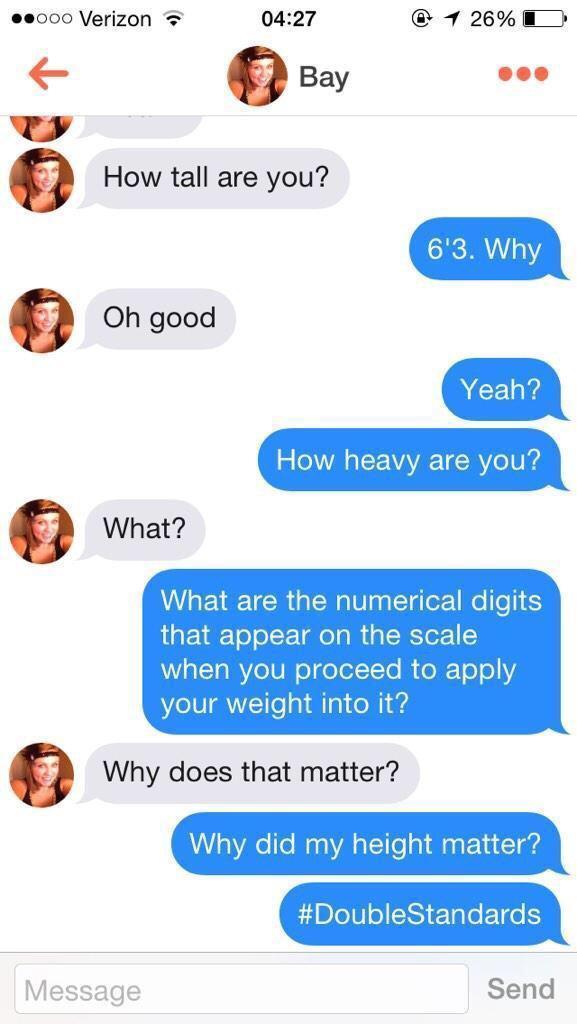
The double standard


I think my favorite part is the explanation. "What are the numerical digits...?"

Friday, 7 November 2014

Avoid the Human Black Hole

Heartiste provides some useful red flags:
Some other forms of female attention whoring are:

- Cutting into conversations with a frequency and assumed authority that could be described as pathological.

- Evincing an astounding lack of self-awareness or humility.

- An inability to listen while simultaneously demanding rapt attention from her human sounding boards.

- A facility tossing out breezy insults that stands in stark contrast to her thin-skinned pique when she perceives herself being attacked.

- A curious lack of fulfillment when she receives the attention she was goading, and a spiral of excitement when her attention seeking is ignored or cavalierly dismissed.

- A preternatural talent for getting into “scrapes” and making “scenes” where she is cast, yet again, as the wholly innocent flashpoint of the drama that magically follows her everywhere.

- Aggravating her mark to the point of exasperation or even anger. An attention whore prefers positive attention but will take negative attention if the former isn’t possible to bait.
All women appreciate and seek male attention, but there is a difference between attention-seeking, which is normal behavior, and attention-whoring, which is not. It's vital to learn the difference, because no one man is ever capable of providing an attention whore with the constant attention that she craves.

For me, the most important signifier is an inability to listen. If a woman asks you a question, then can't even manage to listen to any answer in more depth than "yes" or "no", you probably don't want to take the risk of involving yourself with her. I, personally, don't waste my time on attention whores, as there are few things on the planet less interesting than human black holes.

Tuesday, 4 November 2014

Internal inconsistencies

How, exactly, do the feminists and pinkshirts propose solving this "problem"?
Women fighting for a broader presence in the upper levels of management face at least one very personal obstacle: Most workers don’t want them there. Only one-fifth of people surveyed by Gallup this week said they preferred a female boss over a man. One-third preferred a male boss, and the rest had no preference.

The survey, which collected responses from 1,032 adults living in the U.S., found women were more likely than men to want a male boss: 39 percent of women wanted to be led by a man, compared with 26 percent of men.

In the 60 years that Gallup has conducted this survey, women have never preferred a female boss.
Women are MORE LIKELY than men to want a male boss. As ever, feminism is riven by its internal inconsistencies. If women don't want female bosses, then how can any true feminist support the idea that there should be more of them? Surely feminism can't be about forcing things they don't want on women.

To the Game-aware, there is no dichotomy. Women are intra-sex competitive and both the female boss and the female underling see the other as her rival for male attention in the office. Furthermore, it is more difficult for a female worker to secure her position under a female superior than under a male one.

That was a rhetorical question, by the way. The answer, as always, is more education to rid those women holding the wrong position of their false consciousness.

Friday, 31 October 2014

Do women make better decisions?

It depends entirely upon your definition of "better":
Mara Mather, a cognitive neuroscientist at the University of Southern California, and Nichole R. Lighthall, a cognitive neuroscientist now at Duke University, are two of the many researchers who have found that under normal circumstances, when everything is low-key and manageable, men and women make decisions about risk in similar ways. We gather the best information we can, we weigh potential costs against potential gains, and then we choose how to act. But add stress to the situation — replicated in the lab by having participants submerge their hands in painfully cold, 35-degree water — and men and women begin to part ways.

Dr. Mather and her team taught people a simple computer gambling game, in which they got points for inflating digital balloons. The more they inflated each balloon, the greater its value, and the risk of popping it. When they were relaxed, men and women took similar risks and averaged a similar number of pumps. But after experiencing the cold water, the stressed women stopped sooner, cashing out their winnings and going with the more guaranteed win. Stressed men did just the opposite. They kept pumping — in one study averaging about 50 percent more pumps than the women — and risking more. In this experiment, the men’s risk-taking earned them more points. But that wasn’t always the case.

In another experiment, researchers asked participants to draw cards from multiple decks, some of which were safe, providing frequent small rewards, and others risky, with infrequent but bigger rewards. They found that the most stressed men drew 21 percent more cards from the risky decks than from the safe ones, compared to the most stressed women, losing more over all.

Across a variety of gambles, the findings were the same: Men took more risks when they were stressed. They became more focused on big wins, even when they were costly and less likely.

Levels of the stress hormone cortisol appear to be a major factor, according to Ruud van den Bos, a neurobiologist at Radboud University in the Netherlands. He and his colleagues have found that the tendency to take more risks when under pressure is stronger in men who experience a larger spike in cortisol. But in women he found that a slight increase in cortisol seemed actually to improve decision-making performance.But the closer the women got to the stressful event, the better their decision making became. Stressed women tended to make more advantageous decisions, looking for smaller, surer successes. Not so for the stressed men. The closer the timer got to zero, the more questionable the men’s decision making became, risking a lot for the slim chance of a big achievement.
What the researchers failed to note is that this actually explains why there are so few female entrepreneurs and why it is much more often men who become very wealthy. The higher the risk, the more likely you are to lose everything, but the higher the potential reward. It's not an accident that many of the most wealthy men have gained, lost, and recovered, large fortunes. Unless your plan is to inherit wealth, accepting high levels of risk is the only way to become very wealthy.

So, what this means is that we could probably use more women in finance and fewer women in technology. We want people chasing risk in startups. We don't want them chasing it in banks.

Monday, 27 October 2014

Women and #GamerGate

Dalrock explains the female compulsion at the root of it all:
Feminism at its core is envy of men and a desire to usurp their position. It would be difficult to overstate just how deep this feeling is. This isn’t just about the apex fallacy, it is about a deep desire to “be one of the guys”.  Any group of men getting together to create or enjoy anything will result in women wanting in. The only question is which category the women belong to. Some will want to try to experience the manly enjoyment/pride directly, and will take real steps to be (like) one of the guys. These are the ones who tend to defend the male space.  They don’t want it ruined because they want to experience it.  But others (a much larger group) will realize that they can’t actually experience this, and will then set out to stamp out what they can’t have.  The first category inadvertently paves the way for the second, assuming they don’t themselves shift priorities mid stream.
This is a remarkable explanation of what we've seen take place in the game industry since 1995. I mention that year because that was the year that I met Brenda Laurel at CGDC just prior to her founding Purple Moon, which was the first serious attempt by a woman to exploit an aspect of the vertical game market that first exploded with Facebook, then mobile.

Laurel is a feminist, with all the problems and issues that entails, but she was not only a legitimate, if pedestrian game developer, she was not at all interested with the rest of the game industry, let alone interested in trying to ruin it. Even the troubled transvestite who calls himself Spacekatgal is more interested in selling his own game than in interfering with other games, his crusade against Assassin's Creed notwithstanding. But the likes of Anita Sarkeesian fall squarely into Dalrock's second group, as she is a parasite whose primary motivation is to invade the male space and destroy it.

Is it "the curse of Eve"? Is it some yet-to-be explained female pathology? Who knows. But it is a repeatedly observable phenomenon.

Saturday, 25 October 2014

The joy of middle-aged spinsterhood

Perhaps women would be less keen to leave it until their 30s to settle down, or to Eat, Pray, Divorce, if they had a better understanding of the way they are running the chance of winding up like these women:
The mid-life shame of moving back in with mum and dad: How failed relationships are forcing more and more middle aged women back into their childhood bedrooms.

‘I always imagined that by my mid-30s I’d be married or at least living with someone and thinking about starting a family. It felt like the right age to settle down, but everything was unravelling. I’d been living with my partner in a rented house but, when we split up, I couldn’t afford the rent on my own. My illness meant I struggled to work and I was under a lot of financial pressure.’

Clare Harrison has a warning for anyone just starting out in the world of work. ‘I envy people with their own homes,’ she says. ‘Yes their lives in their 20s and 30s were more mundane than mine. They didn’t have the adventures I did, they haven’t seen the world like I have. But does that really count for anything? My memories can’t put a roof over my head.’
Now, don't be quick to assume that all women are similarly shortsighted. Remember, women, not men, are the ultimately practical sex. So, the trick simply requires convincing them that they are not special snowflakes who are immune to any such possibilities, which, of course, means playing on their fears.

Or you could simply leave them to feminism and the "every woman can be president one day" approach, which, if nothing else, is amusing to anyone with even a modicum of mathematical ability.

Thursday, 23 October 2014

All they really want is attention

A woman notices Roosh and me criticizing Chris Kluwe on Twitter and desperately wants to get some of that precious, precious male attention:
Bootleg Girl ‏@BootlegGirl
Feel free to pass on the aggro to me! I disagree with you guys too! And I'm a woman! Come get me! @ChrisWarcraft @voxday @rooshv

Vox Day ‏@voxday
@BootlegGirl @rooshv Doxxing will be $99, death threats $199, convincing death threats $250, and for only $499, you can rent a nerd-rapist.
Give her a week and she'll be on MSNBC talking about her near-rape experience on Twitter. And she'll probably burn out her vibrator in the meantime.

Share

Twitter Delicious Facebook Digg Stumbleupon Favorites